This Sunday is the anniversary of the 1963 March on Washington. To commemorate the event, the National Archives is displaying a program from the march in the East Rotunda Gallery and screening The March on August 27 and 28. But if you are not in Washington, DC, you can still watch the entire film on our YouTube … Continue reading From Our Film Archives: “The March”
Category: – Civil Rights
Strange-but-true stories in the struggle for equality
March on Washington: A. Philip Randolph
This coming Sunday is the dedication of the new Martin Luther King, Jr., National Memorial on the National Mall. It's also the 48th anniversary of the March on Washington, when King gave his famous "I Have a Dream" speech to the assembled thousands. As I looked at the program from the day and then at some … Continue reading March on Washington: A. Philip Randolph
Pennsylvania Avenue Hotline
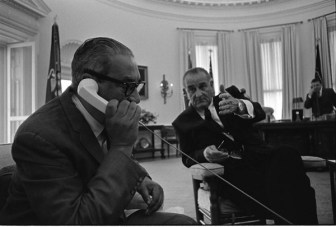
Today's guest post comes from David Coleman, associate professor at the University of Virginia and Chair of the Presidential Recordings Program at the Miller Center of Public Affairs. On April 28, W.W. Norton will publish volumes 7 and 8 in the Miller Center's Presidential Recordings of Lyndon B. Johnson series. (The original tapes are in … Continue reading Pennsylvania Avenue Hotline
Roll out the red carpet at the National Archives!
Today we have a special guest post from Tom Nastick, public programs producer at the National Archives. This week, from February 23 to 27, we’ll be presenting the seventh annual free screenings of Oscar®-nominated documentaries and Short Subjects in the William G. McGowan Theater. Our friends at the Academy of Motion Picture Arts & Sciences will … Continue reading Roll out the red carpet at the National Archives!
Baseball and the 13th Amendment
January 31, 1865, was a busy day for the war-torn United States. The House of Representatives passed a constitutional amendment to abolish slavery. Meanwhile, Robert E. Lee was named general-in-chief of the Confederate armies. On January 31, 1919—50 years to the day after slavery was abolished—Jackie Robinson was born in Cairo, Georgia. On April 10, 1947—82 years after the … Continue reading Baseball and the 13th Amendment
January 18, 1964 – Martin Luther King, Jr. & LBJ
Martin Luther King, Jr., would have been 82 on January 15, and yesterday we observed the national holiday in his honor. The above photograph shows a January 18, 1964, White House meeting between four civil rights leaders—Roy Wilkins, James Farmer, Martin Luther King, Jr., and Whitney Young—and President Lyndon Johnson. A civil rights bill was stuck in the … Continue reading January 18, 1964 – Martin Luther King, Jr. & LBJ
Top Ten Pieces of History for 2010
Since April 2010, we've brought you more than 100 Pieces of History. Nothing too small, too strange, or too obscure has escaped the spotlight of our blog or the scalpel of your clever comments. And we are still discovering new pieces of history every day here at the National Archives! But before we go forward into … Continue reading Top Ten Pieces of History for 2010
Four paragraphs, five years of war
Today's post comes from National Archives Office of Strategy and Communications staff writer Rob Crotty. Today in 1860, 169 delegates convened in Columbia, South Carolina, to discuss the fate of their state. The decision was unanimous: South Carolina would secede from the Union. Declared in a terse four paragraphs, the Declaration of Secession set out … Continue reading Four paragraphs, five years of war
The other 13th Amendment
Today's post comes from National Archives Office of Strategy and Communications staff writer Rob Crotty. The year 1861 was a dire one for the United States. In its opening months, five southern states joined South Carolina in seceding from the Union. In the recent 1860 election, the victor Abraham Lincoln hadn't even appeared on the … Continue reading The other 13th Amendment
Lincoln to Slaves: Go Somewhere Else
Today's post comes from National Archives Office of Strategy and Communications staff writer Rob Crotty. The issue of slavery divided the country under Abraham Lincoln's Presidency. The national argument was simple: either keep slavery or abolish it. But Abraham Lincoln, known as the Great Emancipator, may have also been known as the Great Colonizer when … Continue reading Lincoln to Slaves: Go Somewhere Else